

In July, I completed AMI (Association Montessori Internationale) 0-3 Assistant Course and got the certificate this week (yeah!). I’d like to share what the course is about and how I am benefited as parent from this course briefly here.
What is AMI?
The Association Montessori Internationale (AMI) was founded in 1929 by Maria Montessori to maintain the integrity of her life’s work, and to ensure that it would be perpetuated after her death. AMI is the recognised international authority on Montessori education. During its long history AMI has fostered the growth and development of Montessori programmes and teacher training, and worked to support the development and education of children and young adults in a vast variety of settings throughout the world.
https://montessori-ami.org/
What is AMI 0-3 Assistant Course?
The intention of the Assistants Course is to help interested adults become able assistants in a Montessori Nido or Infant Community.
https://montessori-ami.org/
The course from Beijing Training Center is a three weeks long course (all online due to the pandamic). There were 7 hours online course each week. In addition, you will need to have about 13 hours per week of directed study, including recorded lectures, videos, readings, etc. To complete the course, you need to write three papers (500 words each), have nine hours of observation and write the observation journal, and make/prepare a material. The tuition fee is ¥6800 (about $971) from Beijing Training Center. The course brochure can be found from AMI site.
Why did I take AMI 0-3 Assistant Course from Beijing Training Center?
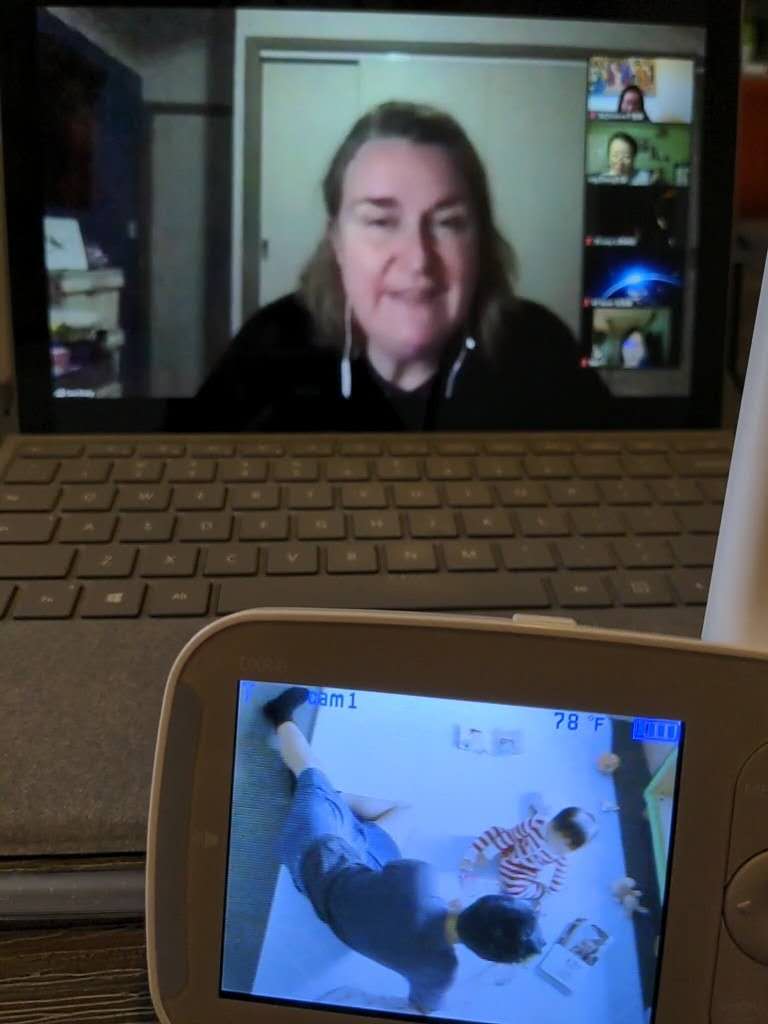
I was checking AMI 3-6 diploma program from WMI (Washington Montessori Institute) in Maryland earlier when I first planned to know more about Montessori and take AMI courses. But due to the pandamic, the courses would be moved to online this year. Later, I noticed the 2020 summer program was even cancelled. For the diploma courses, I truly doesn’t want it to be online, but in-person. So I started to consider taking AMI 0-3 assistant course first as Therese’s 16 months and we will have another baby soon this year. I learnt that Beijing Training Center would offer AMI 0-3 Assistant Course in July and the online course time works well with my schedule (6:30 a.m. to 8:45 a.m. ETS) as Therese is still sleeping or just woke up.
My trainer is Sara Brady, who lives in Sydney with her husband and three children (son and two twins sisters). There were two Chinese translators through the courses, doing simultaneous interpretation. However, we do have students in the class only speaking English. I also did all my homework (3 papers and 43-page observation journal) in English. It takes longer to get feedback (yeh, students would be asked to resubmit their homework if it didn’t meet the standard, and there seems many), but it’s not a problem.
How am I benefited as parent from this course?
Before the course, I’ve been learning Montessori through different ways, like reading Montessori books, listening to podcast, watching lectures from AMI trainer Jack Yu, and reading other moms and teachers’ posts on social medias. I also established a WeChat group about Montessori at Home which has more than 150 members since May when it’s first created. I LOVE that group! There are many good ideas and discussions from Montessori moms and teachers.
From the 0-3 Assistant Course, Sara covers topics including the Absorbent Mind, Observation, Movement, Language, Independent Toileting, Independent Sleeping, Freedom and Self-discipline. The recorded lectures cover the topics including Maria Montessori’s Life and Work, the History of Assistants to Infancy, the Four Planes of Development, the Human Tendencies, the Sensitive Periods, the Process of Adaptation, Grace and Courtesy, the Prepared Environment, Freedom and Self-discipline, and Preparation and Role of the Adult.
This course also emphasizes how important observation is for adults to understand children more. With that basic understanding of the child’s absorbent mind, it becomes clear that observation is very important. Observation allows the adult to discern whether a child has been provided with an environment suited to that child’s needs and to identify situations where that environment may need to be adjusted (such as when the child is going through a sensitive period). In order to observe properly, adults must be present (in body and mind) and seek to maintain a non-judgmental attitude. Observation should focus primarily on movements, communication, cognitive development, social development, emotional development, and independence. The adult must observe the child carefully and design their environment wisely (including by providing appropriate activities and tools to allow the child to make full use of sensitive periods). The adult should observe the process and remove any obstacles from the environment (physical or human) that might hinder the child.
For the observation assignment, we were asked to do a 9-hours observation and write the observation journal (15 minutes a block), either using the videos from the training center or any child under 3. The child I observed for 9 hours was my cutie Therese! I’m so glad I did it as I knew more about her through the observation. In the beginning, I did most observation through monitor when she’s in her bedroom (before sleeping and after waking up). During weekends, I was able to observe her when Mark’s interacting with her. Then I started to write observation journal when I was with her, but it didn’t work out very well. So I videotaped her activities when I was around and write the observation journal later when I watch those videos. I ended writing 43 pages observation journal, but it’s so fun!!
For this course, I also made a Montessori placemat. Before the course started, I was planning to make placemats anyway and dear Louisa gave me some beautiful cloth already. I only need to hemmed one edge and sewed it as the other three edges were well hemmed already. I placed a set of a cut paper utensils and a tea cup on top of the placemat and traced them with the pencil. Then I hand stitch around the lines I had drawn with a light orange color to coordinate with the fabric color and the rose at the left top corner. I could’ve use a deeper color to make the lines more obvious, but the set I ordered from Amazon has limited choices. As I plan to make more placemats, I will try different colors. Therese has been using the placemat I made.


At the end, I really want to say thank you to my dear husband Mark who supports me and my cutie Therese who coorprates so well. It’s not easy when you have a 16-months around and a 5-months in your belly when taking this course. But I did it(!!!), and I believe anyone who wants to do it can make it as well!

If you have any questions about the course, please leave a comment or send me a message. I’d be happy to answer!

 Joyful Christine